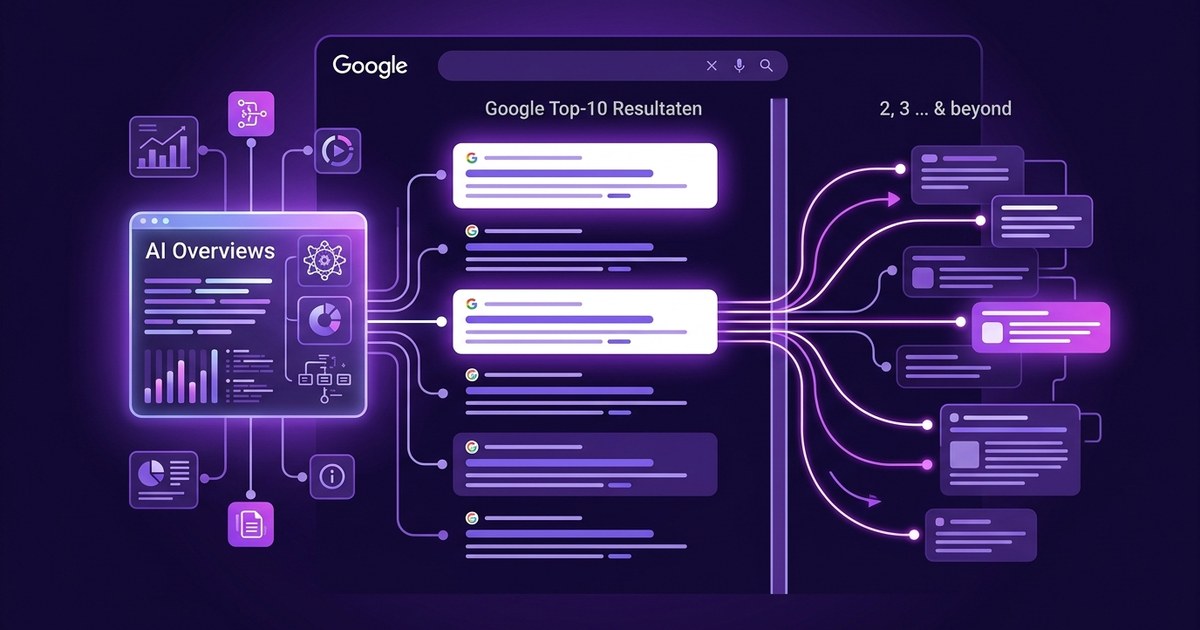
A major new study from Washington University in St. Louis offers surprising insights into how Google selects sources for AI Overviews. The research, which analysed more than 55,000 search queries, reveals that almost 30 per cent of web pages cited in AI Overviews do not appear on the first page of standard Google search results.
For a long time, it was assumed that securing a top-10 position in traditional search results was a strict prerequisite for being included in an AI Overview. However, the data now demonstrates that Google’s AI system uses a separate process to retrieve and summarise information. Employing techniques such as Retrieval-Augmented Generation (RAG) and ‘query fan-out’, the AI model searches for specific, relevant answers to sub-questions. In doing so, it regularly cites deeper web pages or niche sources that rank organically on page two or below.
Why this matters for GEO and SEO
For business owners and marketers, this shifts the very definition of search engine visibility. Traditional SEO primarily focuses on landing a coveted spot on Google’s first page. Generative Engine Optimisation (GEO), on the other hand, demands that your content is direct, factual, and sufficiently robust to serve as an information source for the language model.
This leads to two key takeaways:
- Opportunities for smaller players: You do not always need the highest domain authority or a top-10 ranking to be cited by AI.
- A dual strategy is required: A high SEO ranking does not automatically guarantee that AI will use your content, and vice versa.
What does this mean for you?
To maintain optimal visibility in AI-driven search queries, it pays to adjust your content strategy:
- Answer specific questions directly: Structure paragraphs so that they stand alone and are easy for an AI system to process.
- Focus on depth and unique facts: Pack articles with concrete data, statistics, and clear definitions rather than generic commentary.
- Analyse your AI visibility separately from SEO: Do not fixate solely on traditional rank trackers. Keep track of the specific queries for which your pages appear as a source in AI Overviews.
By building clear, information-rich content, you increase the likelihood that AI assistants will cite your brand as a trusted source — even if your standard search ranking is still lagging behind.
Source: Search Engine Land